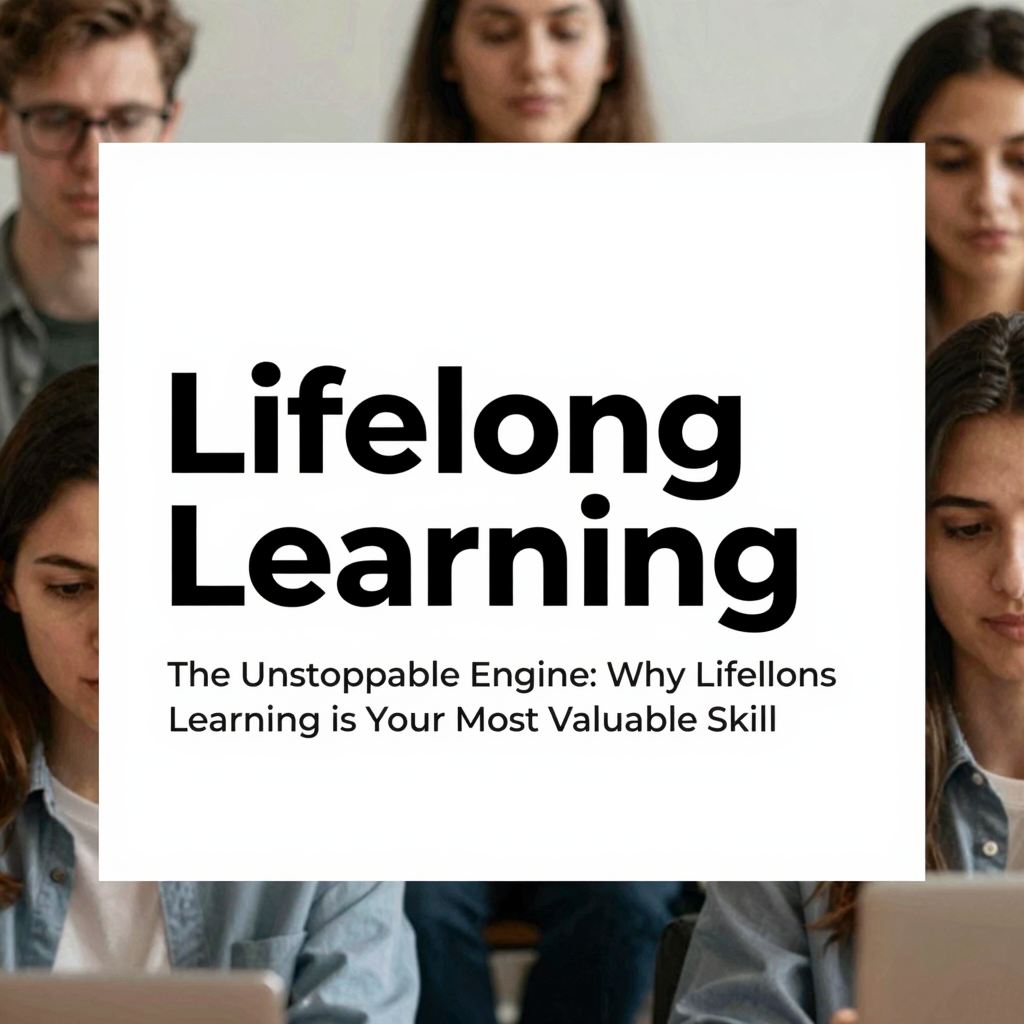
Imagine if your career, your mind, and your very sense of self were built on a foundation of sand. Every few years, a technological tide or a cultural shift sweeps in, eroding what you know, forcing you to scramble for solid ground. For many, this feeling is all too real in our era of relentless change. Now, imagine a different foundation: not static stone, but a living, growing, deeply rooted tree. Its roots draw nourishment from new ideas, its branches adapt to changing seasons, and it grows stronger with each passing year. This is the power of lifelong learning. It is no longer a lofty ideal for academics or a hobby for the intellectually curious; it is the fundamental, non-negotiable engine for professional relevance, personal fulfillment, and navigating a world in permanent beta.
Gone are the days when education was a single, finite phase—a suitcase packed in your youth that you carried unopened through a 40-year career. That model is shattered. The half-life of skills is shrinking rapidly. A technical skill learned today may be obsolete in a handful of years. Industries are born and transformed at breakneck speed. In this landscape, the most critical skill you can possess is the ability and willingness to learn, unlearn, and relearn. Lifelong learning is the thread that weaves through every successful career pivot, every adaptation to new tools, and every moment of insightful problem-solving. It transforms you from a passive passenger in your own life to the active pilot, charting a course through uncertainty with curiosity as your compass.
Beyond the Diploma: Redefining Learning for Life
The first step to embracing lifelong learning is to dismantle our inherited, institutionalized view of what learning is. We must move it from the lecture hall and into the fabric of our daily existence.
From Finite Event to Continuous State
Formal education conditions us to see learning as a destination: you study, you take the test, you get the grade, you’re done. Lifelong learning rejects this finale. It is a continuous, self-directed process with no final exam and no graduation day. It happens in the 20-minute podcast during your commute, the deep-dive into a software tutorial on a Saturday morning, the thoughtful book that challenges your worldview, or the casual conversation with a colleague from a different department. It is fluid, iterative, and integrated. The goal shifts from accumulating certificates to cultivating competence and understanding.
The Toolkit for the Modern Learner
Fortunately, the tools for this journey are more accessible than ever. You carry a global library in your pocket. The modern lifelong learner curates their own curriculum from an abundance of resources:
- Digital Platforms: Online courses (Coursera, edX, MasterClass), skill-specific platforms (LinkedIn Learning, Skillshare), and the vast university of YouTube.
- Microlearning: Podcasts, newsletters, and article summaries that deliver insights in digestible chunks.
- Communities of Practice: Online forums, professional networks, and mastermind groups where learning is social and collaborative.
- Experiential Learning: The ultimate teacher. Taking on a stretch project at work, volunteering for a new skill, building something, or even teaching a concept to others.
The key is intentionality. It’s not about consuming endless content, but about curating information with purpose and applying it to create new knowledge and capability.
The Multifaceted Rewards of a Learning Mindset
Committing to lifelong learning is an investment that pays compound interest across every domain of your life. The returns are both professional and profoundly personal.
Professional Future-Proofing and Agility
In the job market, continuous learners are the most resilient assets. They demonstrate adaptability, a growth mindset, and intrinsic motivation—qualities highly prized by every forward-thinking organization. Lifelong learning:
- Opens Doors to Opportunity: It allows you to pivot into emerging fields, take on leadership roles requiring new technical literacy, and innovate within your current position.
- Combats Obsolescence: By constantly updating your skill stack, you ensure your expertise evolves alongside your industry, protecting your career from disruption.
- Builds Intellectual Capital: You become a connector of ideas, able to see patterns and solutions that others, with a narrower knowledge base, might miss.
Cognitive Vitality and Personal Enrichment
The benefits far exceed your resume. Neuroscience shows that challenging your brain with new learning builds cognitive reserve, helping to keep your mind sharp as you age. On a personal level, it is a catalyst for growth:
- Fosters Resilience: A learning mindset reframes challenges and failures not as threats, but as valuable data and essential steps in the learning process.
- Fuels Curiosity and Wonder: It rekindles the natural curiosity of childhood, making the world a more interesting and engaging place.
- Enhances Self-Efficacy: Each new thing you master, from a language to a home repair, builds confidence in your ability to figure things out, boosting overall well-being.
Building Your Sustainable Learning Habit
Knowing why to learn is one thing; integrating it into a busy life is another. The secret is not monumental effort, but consistent, sustainable practice.
Start with “Micro-Habits” and Curiosity
Forget vowing to “get a new degree.” Start infinitesimally small. Commit to 10 minutes a day. Listen to an educational podcast while making dinner. Read one industry article with your morning coffee. Follow a thought leader on social media who shares quality insights. The goal is to wire the habit, not achieve a massive output. Anchor your learning to a curiosity you already have. Always wanted to understand blockchain? Fascinated by Roman history? Start there. Intrinsic interest is the fuel that makes the habit self-sustaining.
Create a Personal Learning Plan (PLP)
Bring structure to your intentions. A simple PLP can be a note on your phone or a single document. Outline:
- Focus Areas: What do you want to learn? (e.g., Data Visualization, Spanish, Project Management Fundamentals).
- Resources: The specific course, book, or tool you’ll use.
- Time Commitment: Realistic slots in your weekly calendar (“Tues/Thurs 7:30-8:00 PM”).
- Application: How will you use this knowledge? (Build a dashboard, order food in Spanish, lead the next team project).
Review and adjust this plan quarterly. It’s your roadmap, not a rigid contract.
Embrace the Discomfort of the “Learning Zone”
Real growth happens outside your comfort zone, in the “learning zone”—that space where you are challenged and might feel frustrated or clumsy. Expect it. When learning a new software, you will fumble. When studying a complex theory, you will have to re-read paragraphs. This is not failure; this is the active process of building new neural pathways. Be patient with yourself. Reflect on what you’re learning, make notes, and teach the concept to someone else. This active engagement solidifies the knowledge.
The Never-Ending Journey
Lifelong learning is not a race with a finish line; it is the path itself. It is a conscious choice to remain open, malleable, and engaged with the world’s endless complexity. In a culture that often values quick fixes and definitive answers, it is a commitment to asking better questions. It acknowledges that mastery is not a plateau to be reached and settled upon, but a horizon that continually recedes, inviting you forward.
Ultimately, adopting a lifestyle of continuous learning is the most powerful statement you can make about your own agency. It says that you are not defined by what you knew yesterday, but by your capacity to understand tomorrow. You are choosing to grow your own capabilities, to nurture your curiosity, and to build a life that is not reactive to change, but energized by it. So, start today. Pick one thing that piques your interest, dedicate a few minutes to it, and begin stoking that unstoppable engine within. Your future self will thank you for the journey.